
13 June 2026
Get More Work as a Contractor: 7 Things to Fix First

By Shaun, Founder of QuoteCore+. Reviewed 13 June 2026.
Most contractors don't struggle because they're bad at the work. They struggle because getting the work is often left to chance.
A referral comes in. Someone sees the van. A past customer passes your number on. That all helps, and word of mouth will always matter in the trades, but it is not a proper system. If the phone goes quiet for a week or two, you need more than hope and a few old contacts to keep work coming in. If you are starting from scratch, our guide to starting a roofing business in the UK covers the foundations.
The good news is you do not need to become a marketing expert. You do not need to post online every day, run complicated ads, or spend thousands on a new website. For most contractors, getting more work starts with fixing the basics that customers already look at before they choose who to call.
That means showing up locally, looking trustworthy, asking happy customers for reviews, following up properly, and sending quotes that make people feel confident hiring you.
Here are the areas worth fixing first.
1. Get your Google Business Profile sorted
When someone searches for a roofer, builder, electrician, plumber, landscaper, or any other trade near them, Google is usually the first place they go. If your business does not show up properly, you are invisible to a large chunk of people already looking for the exact work you do.
Your Google Business Profile does not need to be perfect, but it does need to look alive. At a minimum, your business name, phone number, service areas, opening hours, and website or contact link should all be correct. Your services should also be listed clearly. "Roofing" is fine, but "flat roof repairs", "fascia and soffit replacement", "gutter repairs", or "new roof installation" gives people a much better idea of what you actually do.
Photos matter too. A few pictures of finished jobs, your van, your team on site, or even a clean before-and-after can make a big difference. Customers want to see proof that you are real, local, and actually doing the work you say you do.
Most contractors set their Google profile up once and then forget about it. The businesses that update it regularly with new photos, posts, and reviews usually look more active and more trustworthy. You do not need to overthink it. One new job photo a week is better than leaving the same old three photos sitting there for years.
2. Ask for reviews while the customer is still happy
Reviews are the online version of word of mouth. A contractor with plenty of genuine four and five-star reviews will usually get more enquiries than one with none, even if the one with no reviews is excellent at the job.
The problem is that most happy customers do not leave a review unless you ask. They might be pleased with the work, they might recommend you in conversation, but they probably will not go out of their way to find your Google profile and write something unless you make it easy.
The best time to ask is when the job has just finished and the customer is happy. Send a short message the same day or the next morning with your review link. Keep it simple and human. Something like:
"Really glad you're happy with the work. If you have a minute, a quick Google review would really help us out."
That is enough. You do not need to beg, offer discounts, or make it awkward. Just make it part of how you finish a job.
If you can get one new review a week, your profile will look completely different in six months. That steady build-up of social proof can do more for your business than a lot of paid marketing.
3. Follow up every quote you send
A lot of contractors send a quote and then wait. If the customer does not reply, they assume the job has gone elsewhere and move on.
Sometimes that is true. Sometimes the customer chose someone cheaper, changed their mind, or decided not to do the work at all. But plenty of the time, they are just busy. They saw the quote, meant to reply, then got distracted by work, kids, bills, or ten other things.
A simple follow-up two or three days after sending the quote can win jobs that would otherwise disappear.
It does not need to be pushy. In fact, it should not be. A quick message like this is enough:
"Hi, just checking you received the quote okay. Happy to answer any questions."
That one message can restart the conversation. It gives the customer a chance to ask something, clarify the price, check timings, or simply say yes.
The hard part is not writing the message. The hard part is remembering who needs following up, which quotes are still open, and which customers have already replied. Once you are sending more than a handful of quotes a week, trying to track it all in your head, WhatsApp, emails, and spreadsheets gets messy quickly.
That is where a proper quoting workflow starts to matter. If a quote has gone out, it should have a status. If no one has replied, there should be a clear next step. Otherwise, work slips through the cracks and you do not even realise it.
The fastest contractors have a repeatable process for this - one that gets a quote in the client's inbox the same day as the site visit. The Construction Quote Speed Checklist breaks that process into four stages you can run through every time.
4. Make your quotes look professional
Customers are not just comparing prices. They are comparing confidence.
If they receive three quotes and one is vague, one is a quick text message, and one is clear, detailed, and professional, the professional quote already has an advantage. Even if it is not the cheapest, it gives the customer more trust in the person sending it.
A good quote should explain what is included, what is not included, the price, the expected timeline, and any important details about the job. It should have your business name, contact details, and ideally your logo. It should look like it came from a serious business, not something quickly thrown together in the van between jobs.
This does not mean making the quote fancy. Customers do not need a design masterpiece. They need clarity. They want to know what they are paying for, what happens next, and whether they can trust you to do the job properly.
The quality of your quote affects how people see the quality of your work. That might not always be fair, but it is how customers make decisions. A messy quote can make good work look less reliable. A clear quote can make a business feel more organised before the job has even started.
See how a professional quote comes together
A clear quote helps the customer trust you sooner. This walkthrough shows how QuoteCore+ helps turn job details and measurements into a professional quote, then keeps the follow-up and next steps connected.
If you are still putting quotes together manually, here is how UK roofers are using digital quoting to send better quotes faster - and what that means for winning work. For the full pricing process, see How to Price a Roofing Job: Step-by-Step Pricing Guide. If you are comparing platforms, our guide to the best quoting software for NZ tradies covers the options in detail.
5. Ask for referrals properly
Happy customers are one of the best sources of future work, but most contractors leave referrals to chance.
A customer might recommend you if someone asks, but they may not think to do it on their own. That does not mean they are unhappy. It just means they are getting on with their life. If you want more referrals, you need to ask in a normal, low-pressure way.
At the end of a good job, once the customer is happy, you can say:
"If you know anyone else who needs similar work, we'd really appreciate the recommendation."
That is all it takes. No big speech. No awkward sales pitch. Just a reminder.
You can also add it into your final message after the job is complete. If you are already thanking them, sending care instructions, or asking for a review, it is easy to include a referral line as well.
Referrals work because trust transfers. If someone's neighbour, friend, or family member says you did a good job, that new customer is already warmer before they ever speak to you.
6. Show your work online
Trades businesses are visual. A finished roof, a new bathroom, a clean extension, a repaired driveway, a tidy bit of landscaping, or a before-and-after from a messy job tells people more than a polished paragraph ever could.
You do not need to become a content creator. You do not need to dance on TikTok or post every day. You just need to show proof that you are doing good work.
A simple before-and-after photo once a week is enough to start. Take the photo on your phone, make sure it is clear, and write a short caption explaining what the job was and where it was done.
Something like:
"New fascias and guttering finished this week in Harrogate."
That is not complicated, but it gives local people something to recognise. They see the type of work you do, the area you cover, and the standard you work to. Over time, those small posts build awareness.
The best content for contractors is usually the work itself. Customers want to see real jobs, real results, and signs that you are active in their area.
7. Make sure your website does the basics
You do not need a huge website to get more work. You need a website that answers the customer's basic questions quickly.
What do you do? Where do you work? How can someone contact you? Can they see examples of finished jobs? Does the site work properly on a phone?
That is the minimum.
A lot of contractor websites fail because they try to say too much, look outdated, or make it hard for the customer to take the next step. If someone has to hunt for your phone number, zoom in to read the page, or guess whether you cover their area, they may simply leave and call someone else.
Your homepage should be clear. Your services should be easy to understand. Your contact button or phone number should be obvious. Your photos should show the kind of work you want more of.
If you do not have a website yet, your Google Business Profile can do some of this work for now. That is fine as a starting point. But eventually, having a simple site gives you somewhere to send people, somewhere to show your work properly, and somewhere to build trust before the customer gets in touch.
The quotes you already send are one of your biggest opportunities
A lot of contractors think getting more work means getting more leads. Sometimes it does. But often, the quickest win is converting more of the enquiries and quotes you already have.
If you send ten quotes and win five, the other five are not just "lost". Some may have gone elsewhere, but some may have needed a follow-up. Some may have wanted more detail. Some may have trusted another contractor more because their quote looked clearer and more professional.
That is why your quoting process matters so much. Speed matters. Detail matters. Follow-up matters. If a customer contacts three contractors and you are the first to send a clear, professional quote, you have already made their decision easier. If you then follow up properly, you give yourself another chance to win the job.
This is exactly the kind of workflow QuoteCore+ construction quoting software was built for. It helps trades businesses keep the quoting process organised, from measuring and pricing through to sending the quote, tracking what happens next, creating material orders, managing the job and invoicing. Instead of jobs getting lost across emails, notes, spreadsheets, quote documents and messages, everything stays in one place. For a full list of free tools that can help speed up your workflow, see Best Free Tools for Roofers and Contractors (2026).
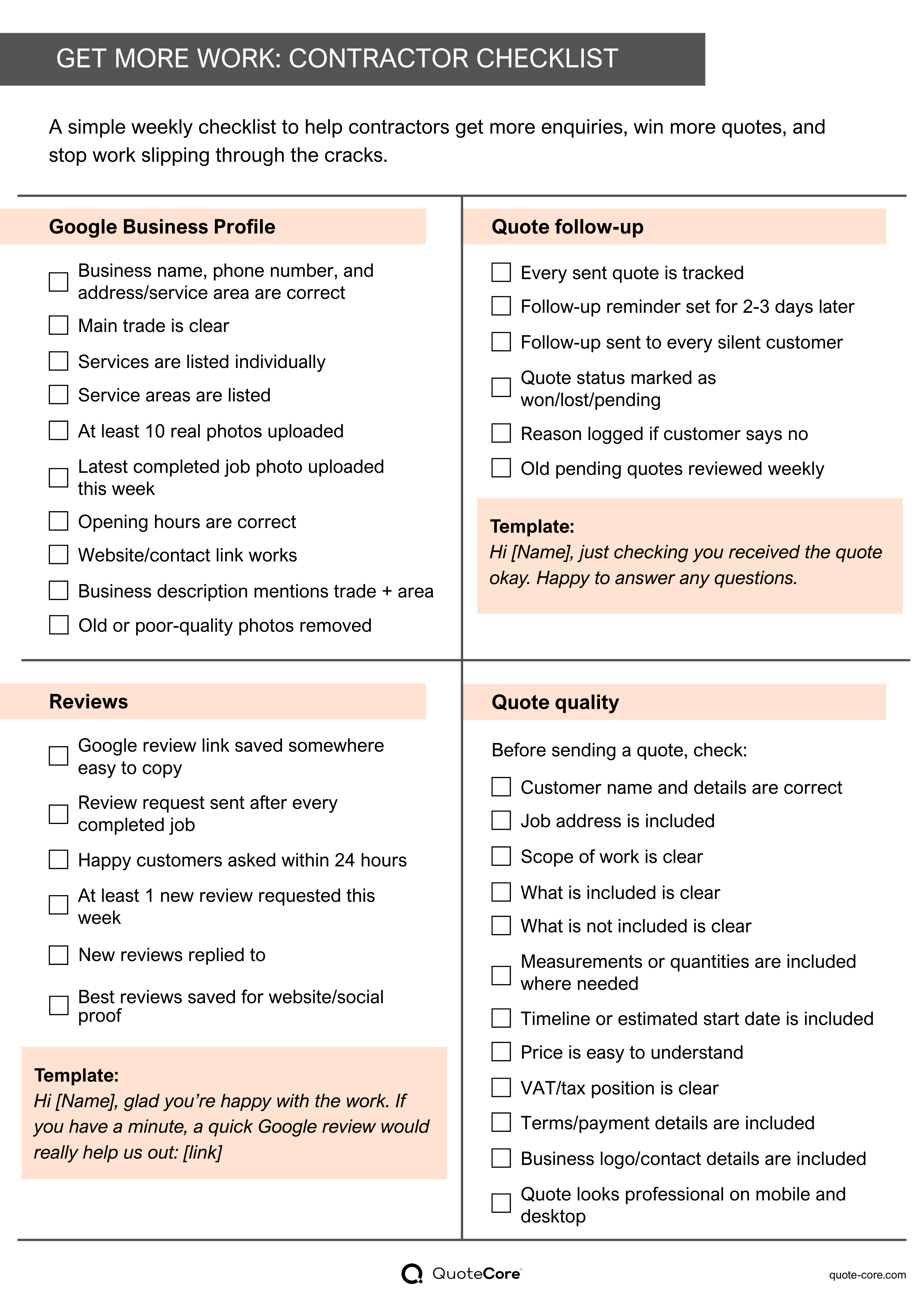
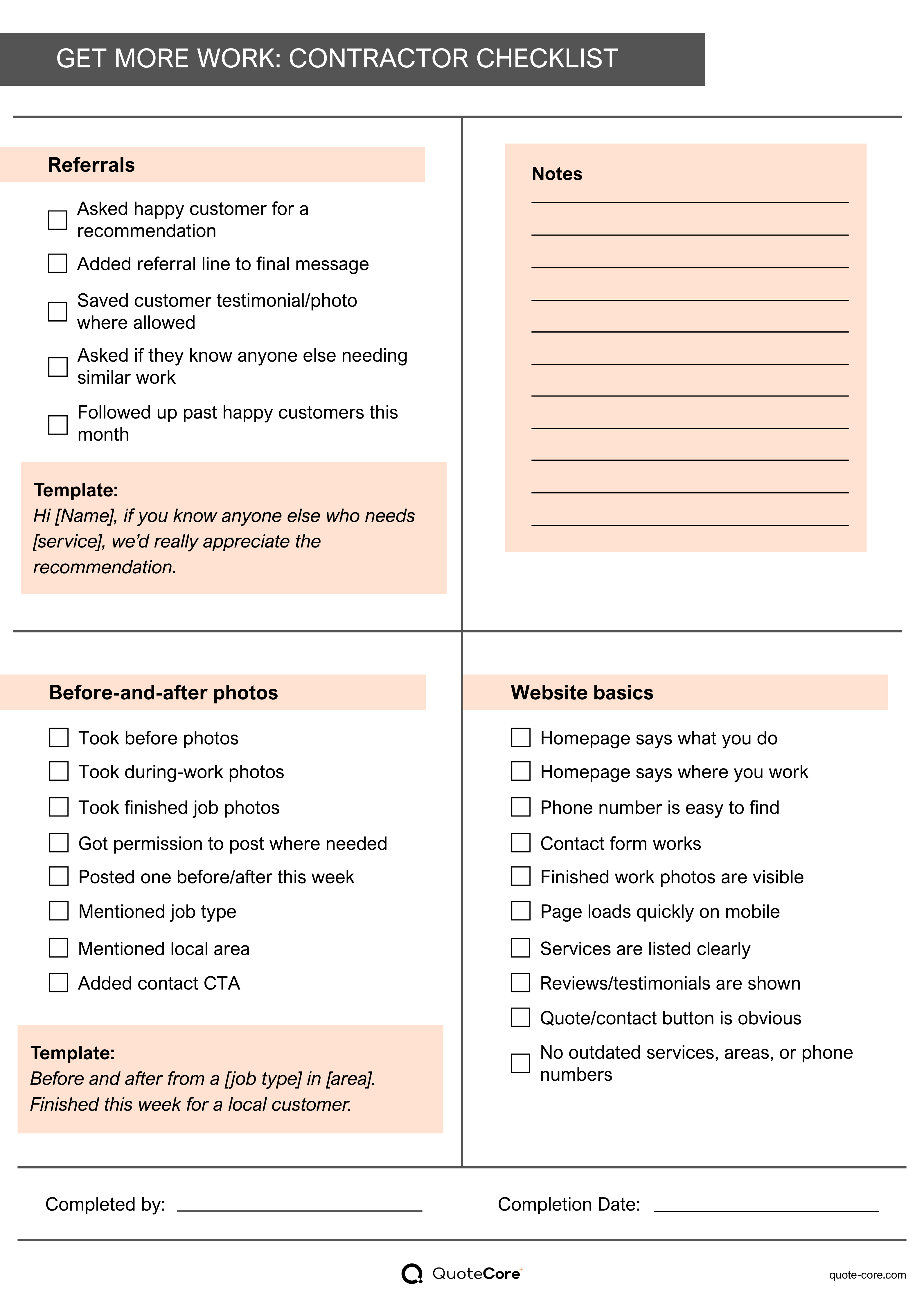
Use this checklist every week
Getting more work is not usually about doing something wildly different. It is about doing the basics more consistently than everyone else. Print this off and use it every week.
Most of your competitors will not do all of that properly.
That is the opportunity.
Ready to quote faster? Build your quotes with the free quote generator - professional, itemised, no signup - and see what the evidence says about professional quotes winning more jobs. Or start your free QuoteCore+ trial today. No card needed. From complex plan to quote in under 3 minutes for less than a dollar.
Ready to quote faster?