
Same area, different roof
Two roofs can both measure 180 square metres and need noticeably different purchased material, because run lengths and cut positions differ.
NZ long-run roofing estimating
Roof area alone does not tell you how much long-run roofing to buy. Here is why, and how to plan cut-to-length material properly before the price is fixed.
Area is not purchased material
Two roofs can both measure 180 square metres and need noticeably different purchased material, because run lengths and cut positions differ.
Sheets run from gutter to ridge on each face. Face width and slope length decide how many sheet widths and what ordered lengths the roof consumes.
Ends, junctions and penetrations all leave material behind. Whether that material is usable elsewhere is the question a plain area figure never answers.
Simple roofs vs hips and valleys
On a plain skillion or simple gable roof, most sheets are full-length runs. Quantities are close to area divided by cover width, with modest allowances. Offcut planning adds little here.
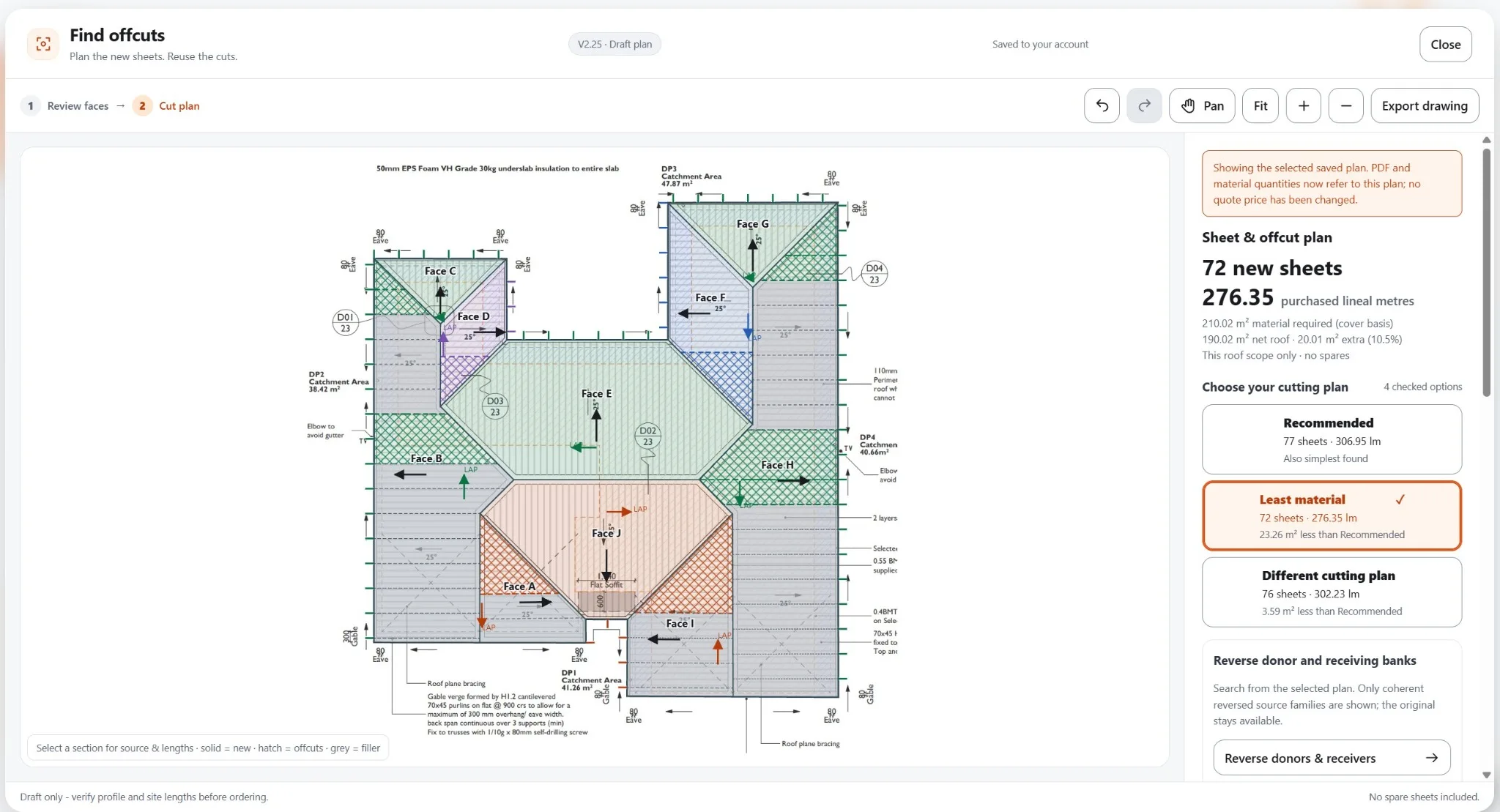
Where planes meet at an angle, sheets must be cut diagonally. Each diagonal cut produces a tapered leftover rather than a clean offcut.
A tapered piece can sometimes supply the matching cut on another face. Whether it does depends on its length, profile and the direction of the next cut.
Short, awkward or wrong-direction pieces have nowhere useful to go. On heavily cut-up roofs, this unusable fraction is where blanket estimates come unstuck.
A blanket 10% or 15% waste allowance is simple, and on uncomplicated roofs it is often close enough. The trouble starts on complex geometry.
We are not claiming a fixed saving figure. The point is simpler: the purchased material for a long-run roof is knowable before quoting, so it is worth checking rather than guessing.
Practical workflow
Establish the reviewed roof geometry: areas, faces, slopes and junctions from takeoff or plan measurement.
Fix the sheet direction and the ordered lengths the supplier sells for each face.
Identify where hips, valleys and other junctions force diagonal cuts.
Work out which tapered leftovers can realistically be reused on another face.
Calculate the sheets and lengths you would actually buy, not the area.
Price the job from that material requirement, so the quote carries a defensible allowance.
How QuoteCore+ helps
Measure the roof in metric from plans or on site. The geometry feeds everything downstream.
Generates suggested whole-roof cutting plans from the reviewed takeoff, so sheet counts, purchased lengths and reusable offcuts are visible before pricing. See the feature.
The material requirement flows into the quote, and accepted work becomes a supplier order with lengths and quantities carried over. See the NZ quoting workflow.
Next steps
Show us how you currently estimate long-run work and we will walk the workflow against your process. No obligation.
Book the callSet up your workspace and start measuring, pricing and quoting in metric.
Create a free workspaceFAQ
Practical answers about how QuoteCore+ fits into real estimating, takeoff and quoting workflows.
Long-run roofing is ordered as real sheet lengths, not by the square metre. Two roofs with the same measured area can need very different purchased material depending on run lengths, sheet direction and where the angled cuts fall.
Hips and valleys force diagonal cuts across the sheet. Each diagonal cut leaves a triangular or tapered leftover. Some of those pieces can be reused on another face, and others cannot, because of length, profile or fixing position.
There is no reliable single number. A blanket 10% or 15% can be too high on a simple gable and too low on a complex hip and valley roof. The geometry of the specific roof is what determines the extra material.
Sometimes. An offcut is reusable when its profile, length and cut geometry match what another part of the roof needs. Offcut planning exists precisely because that matching is hard to do reliably in your head.
The Offcut Optimiser turns a reviewed roof takeoff into suggested whole-roof cutting plans, showing likely sheet counts, purchased lengths and reusable offcuts before the quote is priced. See the feature page for how it works.
No. The estimating problem applies anywhere cut-to-length metal roofing is used, including Australia and other markets. This page frames it for NZ long-run roofing because that is where the question comes up most.
Related
QuoteCore+
Plan the cuts and purchased lengths before the quote is sent, and the margin survives contact with the material order.